Google’s AI Assistant Now Calls Stores for You
Imagine a world where you no longer have to spend hours calling multiple stores to check if they have that specific item you need. Thanks to Google’s latest innovation, that world is now a reality. Google is rolling out a new feature that allows its AI assistant to robocall stores on your behalf, saving you time and effort. This groundbreaking tool promises to revolutionize how we shop locally, providing a seamless and efficient way to find the products we need. This feature represents a significant step forward in leveraging AI to enhance everyday consumer experiences.
The new feature is designed to simplify the process of finding products at local stores. Instead of manually calling each store, users can now instruct Google to do it for them. The AI assistant will call the stores, inquire about product availability and pricing, and then provide the user with a comprehensive summary of the findings. This not only saves time but also ensures that users have the most up-to-date information before heading to the store. As Google continues to integrate AI into its services, features like this demonstrate a commitment to making technology more useful and accessible.
How the Google Robocall Feature Works
The process is remarkably straightforward. When you search for a product on Google Search and include “near me” in your query, the feature becomes available. If the product is supported, you’ll see a “Let Google Call” button. Tapping this button initiates the AI-powered robocall. Here’s a step-by-step breakdown:
- Initiate the Call: Click the “Let Google Call” button.
- Clarifying Questions: The AI will ask a few clarifying questions to understand your specific needs.
- Provide Information: You’ll be asked to fill in your email (or phone number) and address information.
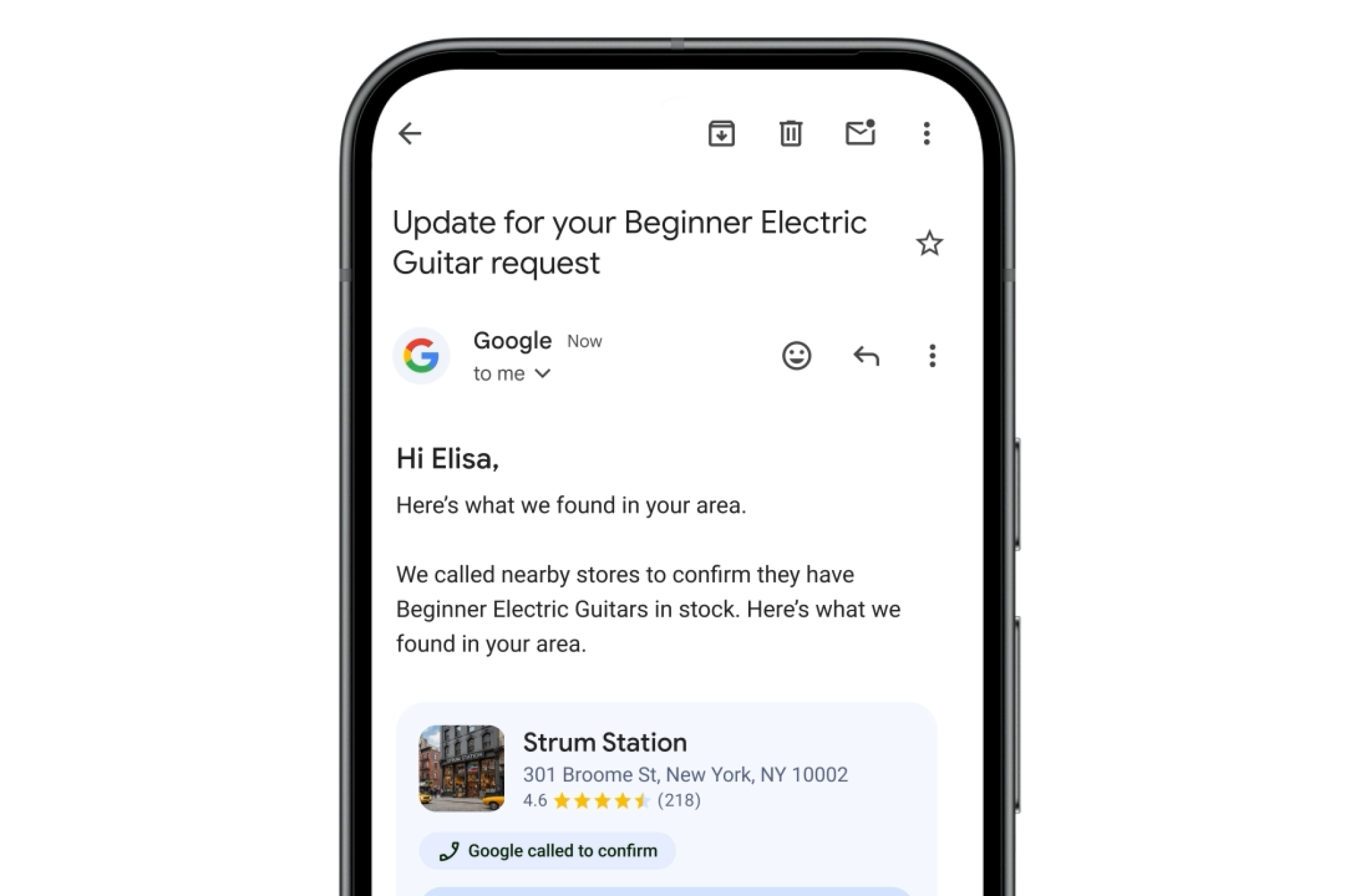
- AI Calls Stores: Google’s AI will then call local businesses on your behalf.
- Gather Information: The AI will inquire about product availability and pricing.
- Receive Summary: You’ll receive an email or text message with the information broken down by store.
This streamlined process ensures that users can quickly and easily find the products they need without the hassle of making multiple phone calls. The AI handles the tedious task of contacting stores, allowing users to focus on making informed purchasing decisions. This feature complements other Google services, such as Google’s Agentic Checkout, which further automates the purchasing process.
The Benefits of Google’s AI Robocall Feature
The benefits of this feature are numerous. First and foremost, it saves users a significant amount of time. Instead of spending hours on the phone, users can simply initiate the AI robocall and receive a summary of the information they need. This is particularly useful for busy individuals who don’t have the time to call multiple stores. Furthermore, the AI ensures that the information is accurate and up-to-date, reducing the risk of heading to a store only to find that the product is out of stock or the price is different from what was expected. The ability of Google to now robocall stores is a huge benefit to consumers.
Another significant benefit is the convenience it offers. Users can initiate the AI robocall from anywhere, whether they’re at home, at work, or on the go. The AI handles the entire process, freeing up users to focus on other tasks. This convenience is particularly valuable in today’s fast-paced world, where time is a precious commodity. Also, for users interested in enhancing their digital lifestyle, exploring options like the Aura Ink digital picture frame can add a touch of art and technology to their homes.
Addressing Concerns and Misconceptions
While the Google AI robocall feature offers numerous benefits, it’s important to address some potential concerns and misconceptions. One common concern is the potential for the AI to be perceived as intrusive or annoying by store employees. To mitigate this, Google has designed the AI to clearly identify itself as an AI calling on behalf of Google. The AI also assures store employees that the information gathered during the call will not be used for training purposes. This transparency helps to build trust and reduce the likelihood of negative reactions.
Another misconception is that the AI robocall will be linked to the user’s personal information. Google has taken steps to ensure that this is not the case. The AI does not reveal the user’s identity to the store employees. Instead, it simply states that it is calling on behalf of Google. This protects the user’s privacy and prevents them from being blacklisted for making too many inquiries. Moreover, it’s important to note that Google is committed to using AI responsibly and ethically. The company has implemented safeguards to prevent the AI from being used for malicious purposes.
The Impact on Local Businesses
The Google AI robocall feature has the potential to significantly impact local businesses. On the one hand, it can drive more traffic to their stores by making it easier for customers to find the products they need. On the other hand, it may also increase the workload for store employees, who will need to respond to the AI’s inquiries. To address this, Google is working to make the AI as efficient and unobtrusive as possible. The AI is designed to ask clear and concise questions, and it is able to understand and respond to store employees’ answers in real-time.
Furthermore, local businesses can benefit from the data gathered by the AI. Google can provide businesses with insights into which products are in high demand and which products are frequently out of stock. This information can help businesses to make better inventory management decisions and improve their overall customer service. By providing these insights, Google is helping local businesses to thrive in an increasingly competitive marketplace. The ability of Google to robocall stores and provide valuable information is a potential game changer for local businesses.
Future Developments and Potential Applications
The Google AI robocall feature is just the beginning. In the future, we can expect to see even more sophisticated AI-powered tools that help us to shop locally. For example, the AI could be used to negotiate prices with stores or to schedule appointments for product demonstrations. The AI could also be integrated with other Google services, such as Google Maps, to provide users with turn-by-turn directions to the stores that have the products they need.
Moreover, the AI could be used in other industries beyond retail. For example, it could be used to call doctors’ offices to schedule appointments or to call restaurants to make reservations. The possibilities are endless. As AI technology continues to evolve, we can expect to see even more innovative applications that make our lives easier and more convenient. And, as technology advances, considering a device like the RedMagic 11 Pro gaming phone might be beneficial for those who enjoy mobile gaming and require high performance.
A Live Demo Experience
At a recent press event, attendees had the opportunity to witness a live demo of the Google AI robocall feature. The demo showcased the AI’s ability to interact with store clerks and gather information effectively. During the demo, a Google employee played the role of a store clerk, while the AI asked questions about product availability and pricing. The employee was able to interrupt the call and refer to previous statements for context without issue. This demonstrated the AI’s ability to understand and respond to human input in real-time.
While the demo was impressive, it’s important to note that it was conducted in a controlled environment. In the real world, store clerks may not always speak clearly and slowly, and the AI may encounter more challenging scenarios. However, Google is continuously working to improve the AI’s performance and to make it more robust and reliable. The company is also gathering feedback from users and store employees to identify areas for improvement. This iterative approach ensures that the AI will continue to evolve and improve over time.
Ethical Considerations and Responsible AI Use
As with any AI technology, it’s important to consider the ethical implications of the Google AI robocall feature. One potential concern is the impact on employment. If AI can handle tasks that were previously performed by humans, it could lead to job losses. To address this concern, it’s important to focus on using AI to augment human capabilities rather than replace them entirely. AI can handle the tedious and repetitive tasks, freeing up humans to focus on more creative and strategic activities. Furthermore, the development and implementation of AI technologies can create new job opportunities in areas such as AI development, data analysis, and AI ethics.
Another ethical consideration is the potential for bias. AI algorithms are trained on data, and if that data is biased, the AI will also be biased. To mitigate this, it’s important to ensure that the data used to train AI algorithms is diverse and representative of the population as a whole. It’s also important to regularly audit AI algorithms to identify and correct any biases that may be present. Google is committed to using AI responsibly and ethically, and the company has implemented safeguards to prevent the AI from being used for malicious purposes. Learning more about the enhanced capabilities of tools like ChatGPT can also offer insights into the ethical considerations of AI development.
The Technical Underpinnings of the AI Robocall
The Google AI robocall feature is powered by a sophisticated combination of technologies, including natural language processing (NLP), speech recognition, and machine learning (ML). NLP allows the AI to understand and interpret human language, while speech recognition enables it to convert spoken words into text. ML algorithms are used to train the AI to identify patterns and make predictions. These technologies work together to enable the AI to interact with store clerks and gather information effectively.
The AI is also designed to be adaptive and to learn from its experiences. As it interacts with more store clerks, it will become better at understanding their answers and at asking relevant questions. This continuous learning process ensures that the AI will continue to improve over time. Furthermore, Google is investing heavily in research and development to further advance the capabilities of its AI technologies. This investment will lead to even more innovative applications in the future.
User Privacy and Data Security
Google takes user privacy and data security very seriously. The company has implemented a number of safeguards to protect users’ personal information. As mentioned earlier, the AI does not reveal the user’s identity to the store employees. Instead, it simply states that it is calling on behalf of Google. Furthermore, Google does not store the audio recordings of the AI’s conversations with store clerks. The audio is processed in real-time and then discarded. This ensures that users’ conversations are not stored or analyzed for any purpose.
Google also provides users with control over their data. Users can choose to opt-out of the AI robocall feature at any time. They can also review and delete their search history and other data that Google has collected about them. Google is committed to being transparent about its data practices and to providing users with the tools they need to protect their privacy. Moreover, users who appreciate advanced technology might find value in exploring devices like the Beats Solo Buds, which offer a seamless audio experience.
Conclusion: A New Era of Local Shopping
Google’s AI robocall feature represents a significant step forward in the evolution of local shopping. By automating the tedious task of calling multiple stores, the AI saves users time and effort. It also ensures that users have the most up-to-date information before heading to the store. While there are some potential concerns and misconceptions, Google is committed to using AI responsibly and ethically. The company has implemented safeguards to protect user privacy and to prevent the AI from being used for malicious purposes. As AI technology continues to evolve, we can expect to see even more innovative applications that make our lives easier and more convenient. The future of local shopping is here, and it’s powered by AI.