Unveiling One UI 8.5: Galaxy S25 Beta Program Commences
The highly anticipated moment has arrived for Samsung enthusiasts and developers alike. Samsung has officially kicked off the Samsung One UI 8.5 Beta for Galaxy S25 series, inviting users to experience the next evolution of its mobile operating system. This significant rollout marks a crucial step in refining the software experience before its public release, offering a sneak peek into the innovations poised to redefine user interaction on Samsung’s flagship devices. The beta program, initially launched in select regions, promises a wealth of new features, performance enhancements, and a refreshed user interface, all built upon the foundational improvements of Android 16 QPR2.

The initial wave of the One UI 8.5 beta program for Galaxy S25 has been made available to users in countries such as South Korea, the US, the UK, Germany, India, and Poland. This strategic phased rollout allows Samsung to gather targeted feedback from diverse user bases, ensuring that the final build is robust, stable, and globally optimized. Early reports and official changelogs confirm a substantial overhaul, focusing on deeper AI integration, enhanced connectivity features, and more granular customization options. For those eager to get a head start, participation in the beta program offers an exclusive opportunity to shape the future of Samsung’s mobile experience and contribute directly to its development cycle.
The Dawn of a New Software Era
Every major One UI update from Samsung is more than just a cosmetic refresh; it represents a significant leap forward in mobile technology, integrating the latest Android innovations with Samsung’s unique ecosystem. One UI 8.5 is no exception, serving as a testament to Samsung’s commitment to delivering a premium, intelligent, and highly personalized smartphone experience. This beta program for the Galaxy S25 series is particularly exciting because it’s the first public-facing iteration of One UI built on Android 16 QPR2, promising a blend of cutting-edge features from both Google and Samsung. Users can anticipate improvements ranging from subtle UI refinements to groundbreaking new functionalities that leverage the powerful hardware of the Galaxy S25.
The overarching theme of One UI 8.5 appears to be intelligence and seamless integration. With the rapid advancements in artificial intelligence, Samsung is positioning its devices at the forefront of this technological wave. The beta program will allow a broad spectrum of users to test these AI capabilities in real-world scenarios, providing invaluable data on their performance, usability, and potential areas for refinement. This collaborative approach between Samsung and its user community is vital for developing software that truly meets the needs and expectations of a diverse global audience, ensuring that the evolution of the One UI 8.5 experience is guided by practical feedback.
Key Innovations and Enhancements in One UI 8.5
The leaked changelog, now largely confirmed by the official beta release, painted a vivid picture of the innovations coming with One UI 8.5. This update is not merely iterative; it introduces several fundamental changes and new features designed to elevate the user experience on the Galaxy S25 series. From enhanced artificial intelligence capabilities to more fluid cross-device interactions, Samsung is pushing the envelope to deliver a truly connected and intelligent ecosystem.
Advanced Galaxy AI Features
At the heart of One UI 8.5 are significant advancements in Galaxy AI. Samsung’s proprietary AI suite is receiving a substantial upgrade, with a particular focus on improved image generation tools. This means users will have access to more sophisticated, intuitive, and powerful AI capabilities for creating and editing visual content directly on their devices. Imagine generating unique wallpapers, enhancing photos with complex edits, or even creating short animated clips with just a few taps, all powered by on-device AI. This emphasis on creative AI tools empowers users to personalize their devices and express themselves in novel ways, moving beyond simple filters to truly transformative image manipulation.
Beyond image generation, Galaxy AI is expected to permeate other aspects of the user experience. This could include smarter content recommendations, more efficient task automation, and even proactive assistance based on user habits and context. The goal is to make the Galaxy S25 not just a tool, but an intelligent companion that anticipates needs and streamlines daily digital interactions. This continuous refinement of AI capabilities underscores Samsung’s strategy to differentiate its flagship devices through smart, user-centric features, making the experience of using a Galaxy S25 more intuitive and powerful than ever before.
Seamless Cross-Device Connectivity
One UI 8.5 also places a strong emphasis on strengthening the bonds within the Samsung ecosystem. The update introduces better cross-device connectivity features, designed to make interactions between your Galaxy S25 and other Samsung devices—such as tablets, smartwatches, and even smart TVs—more fluid and integrated. One notable improvement is enhanced storage sharing capabilities, allowing for easier and faster transfer of files and data between your Samsung devices without cumbersome manual transfers or reliance on third-party services. This is particularly useful for professionals or content creators who frequently switch between devices for different tasks.

Another significant improvement is faster Smart View access. Smart View is Samsung’s feature for mirroring your phone’s screen to a larger display. With One UI 8.5, initiating and managing these connections is expected to be quicker and more reliable, making it ideal for presentations, media consumption, or even extending your workspace. These enhancements are crucial for building a truly integrated digital life, where the boundaries between devices blur, and the user experience remains consistent and efficient. Whether you’re projecting content to a smart TV or exploring deeper integration with car infotainment systems like Android Auto, One UI 8.5 aims to make it effortless.
Enhanced Customization and User Experience
Personalization has always been a cornerstone of One UI, and version 8.5 pushes this further. The update is set to introduce even more granular control over the device’s aesthetics and functionality, allowing users to tailor their Galaxy S25 experience to an unprecedented degree. This could include new theme options, more flexible widget layouts, advanced lock screen customizations, and improved notification management. The goal is to empower users to truly make their device an extension of their personality and workflow, ensuring that every interaction feels intuitive and personally optimized.
Beyond visual customization, improvements to the overall user experience are expected to enhance daily interactions. This might involve redesigned system animations for a smoother feel, more intelligent power management options to extend battery life, or refinements to existing features based on user feedback. Samsung consistently gathers data from its user base to identify pain points and areas for improvement, and the One UI 8.5 beta program is a critical phase for validating these changes before they reach the broader public. The pursuit of a seamless and delightful user experience remains a top priority for Samsung’s software development teams.
Under the Hood: Android 16 QPR2 Integration
A key technical detail often overlooked but critically important is that One UI 8.5 is based on Android 16 QPR2. This means that in addition to Samsung’s proprietary enhancements, the update will also bring major new Android features and under-the-hood optimizations directly from Google. QPR (Quarterly Platform Release) updates typically include significant stability improvements, security patches, and new platform functionalities that developers can leverage. This integration ensures that the Galaxy S25 series remains at the cutting edge of Android development, benefiting from the latest advancements in privacy, performance, and core operating system capabilities.
For users, this translates to a more secure, stable, and feature-rich foundation. Developers, on the other hand, will find new APIs and tools to create more innovative applications that take full advantage of the Galaxy S25’s hardware and the enhanced Android platform. The synergy between Google’s core Android development and Samsung’s One UI customization creates a powerful and versatile operating system, capable of delivering a premium experience across a wide range of use cases, from daily productivity to pushing the boundaries of mobile gaming, even emulating PC titles on Android.
How to Join the One UI 8.5 Beta Program
For eager Galaxy S25 owners looking to get a first-hand experience of the future of Samsung’s software, joining the One UI 8.5 beta program is a straightforward process, albeit with a few important considerations. Participation not only grants early access to new features but also contributes directly to the refinement of the final software, making it a valuable endeavor for both users and Samsung.
Eligibility and Availability
Currently, the One UI 8.5 beta program is specifically targeted at the Galaxy S25 series. This includes the Galaxy S25, Galaxy S25+, and Galaxy S25 Ultra models. As mentioned earlier, the program has initially rolled out in South Korea, the US, the UK, Germany, India, and Poland. Samsung typically expands its beta availability to more regions in the weeks following the initial launch, so users in other countries should keep an eye out for official announcements. Eligibility usually requires owning an unlocked version of the device or a device from a participating carrier, as carrier-locked devices sometimes have delayed beta access due to additional testing requirements.
It’s also important to note that beta programs often have a limited number of slots. While Samsung usually accommodates a large number of participants, it’s advisable to enroll as soon as the program becomes available in your region if you’re keen to participate. Being among the first ensures you don’t miss out on the opportunity to test the latest software and provide feedback.

Steps to Enroll
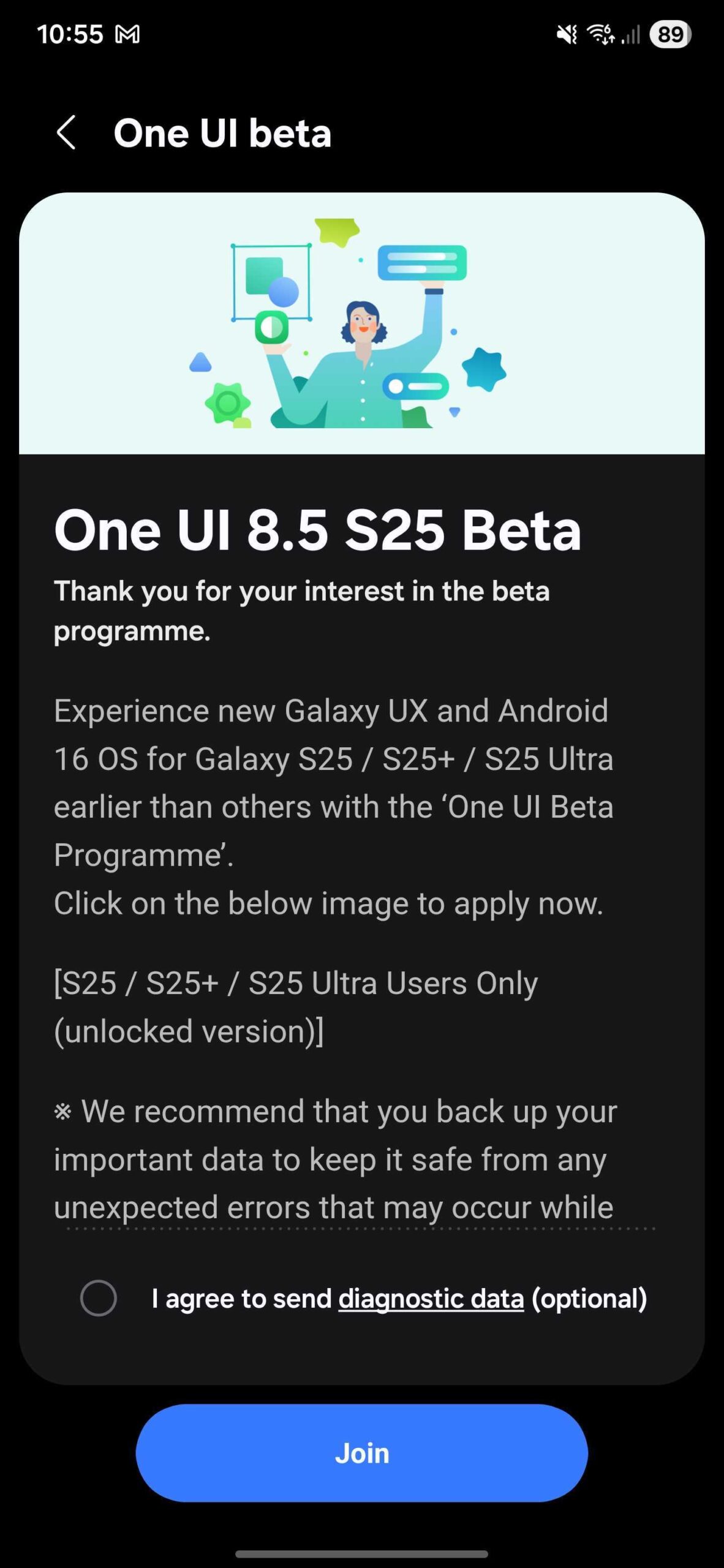
The enrollment process for the Samsung One UI 8.5 beta for Galaxy S25 is generally consistent with previous beta programs. Here’s a general outline of the steps:
- Download Samsung Members App: Ensure you have the Samsung Members application installed on your Galaxy S25 device. This app is the primary portal for beta program registrations and feedback.
- Check for Beta Program Banner: Open the Samsung Members app. On the home screen or in the ‘Notices’ section, look for a banner or announcement regarding the One UI 8.5 Beta Program.
- Register for the Beta: Tap on the banner and follow the on-screen instructions to register. You will likely need to agree to the terms and conditions, which include acknowledging that this is beta software and may contain bugs.
- Check for Update: Once registered, navigate to your device’s Settings > Software update > Download and install. Your device should then detect the One UI 8.5 beta update.
- Install the Update: Download and install the beta software. This process is similar to a regular software update, but it’s recommended to have your device charged and connected to a stable Wi-Fi network.
It’s crucial to back up your device data before installing any beta software, as there’s always a slight risk of data loss or system instability. This precautionary step ensures that your important information remains safe, regardless of any unforeseen issues during the beta testing phase.
Important Considerations Before Joining
While the allure of new features is strong, participating in a beta program comes with certain caveats. Beta software, by definition, is not final. This means you might encounter bugs, performance issues, app crashes, or unexpected battery drain. These are all part of the testing process, and reporting them is a key contribution of beta testers. However, if your Galaxy S25 is your primary device and you rely on it for critical daily tasks without interruption, you might want to reconsider joining the beta program or proceed with caution.
- Stability: Expect varying levels of stability. Some builds might be very smooth, while others could be quite buggy.
- Battery Life: Beta software can sometimes lead to inconsistent battery performance due to unoptimized processes.
- App Compatibility: Certain third-party applications might not be fully compatible with the beta software, leading to crashes or non-functionality.
- Data Backup: Always perform a full backup of your device before installing the beta. This cannot be stressed enough.
- Feedback: Be prepared to actively provide feedback through the Samsung Members app. Your input is crucial for identifying and fixing issues.
Understanding these aspects will help manage expectations and ensure a smoother experience if you decide to jump into the Samsung One UI 8.5 Beta for Galaxy S25.
Deep Dive into Expected Features and Performance
The One UI 8.5 beta for the Galaxy S25 series is not just about a facelift; it’s about fundamentally enhancing how users interact with their devices. The detailed changelog, now being explored by early testers, reveals a host of features that promise to make the Galaxy S25 more intuitive, powerful, and seamlessly integrated into one’s digital life. Let’s delve deeper into some of the most anticipated functionalities.
AI-Powered Image Generation and Editing
Building on the foundation of earlier Galaxy AI iterations, One UI 8.5 significantly boosts image generation and editing capabilities. This isn’t just about applying filters; it’s about generative AI that can intelligently expand images beyond their original borders, remove complex objects with unprecedented precision, or even generate entirely new elements within a scene based on textual prompts. For instance, users might be able to easily extend a landscape photo to fit a different aspect ratio or seamlessly replace a background with a generated one, all within the native Gallery app. This level of on-device AI processing minimizes the need for cloud-based solutions, enhancing privacy and speed.
Furthermore, the AI is expected to offer more intelligent photo suggestions and automatic enhancements. Imagine your phone proactively suggesting optimal edits for your photos based on their content, lighting, and subject matter, or even curating personalized photo albums with generated titles and descriptions. This makes advanced photo manipulation accessible to everyone, not just professional editors, democratizing creative expression on the Galaxy S25. The integration of advanced AI also means a more efficient workflow for managing personal media libraries.
Storage Sharing and Smart View Evolution
The push for a unified Samsung ecosystem is evident in the enhanced storage sharing features. One UI 8.5 aims to simplify the process of accessing and managing files across multiple Samsung devices. Instead of relying on cloud services for every file transfer, users might see options for direct, high-speed local network sharing that treats all connected Samsung devices as parts of a single, extended storage pool. This could involve secure peer-to-peer connections that allow you to pull files from your Galaxy S25 to your Galaxy Tab, or vice versa, with minimal friction. This is especially beneficial for large files like 4K videos or high-resolution images, where cloud uploads can be time-consuming.
The evolution of Smart View is equally significant. Beyond faster access, the update could introduce more advanced mirroring capabilities, such as multi-window support on mirrored screens, allowing users to project multiple apps from their phone onto a larger display simultaneously. Imagine working on a document on your Galaxy S25 while referencing a webpage mirrored to your TV, or sharing content with several people at once. These features transform the Galaxy S25 from a standalone device into a central hub for a connected workspace or entertainment setup, optimizing your home media server experience.
Auracast: A New Dimension of Audio Sharing
One of the more intriguing features mentioned for One UI 8.5 is enhanced Auracast capabilities. Auracast, a new Bluetooth LE Audio feature, allows a single audio source (like your Galaxy S25) to broadcast audio to an unlimited number of nearby compatible Bluetooth devices. This is a game-changer for shared listening experiences. Instead of needing multiple pairs of headphones connected to one device, or struggling with a single speaker, Auracast lets everyone with compatible headphones or speakers tune into the same audio stream simultaneously. This could be perfect for watching a movie with friends on a tablet, sharing music in a public space, or even for public venues broadcasting information.
The “enhanced” aspect in One UI 8.5 suggests further refinements to this technology, potentially including easier pairing, better management of audio streams, or even more robust connection stability. This feature truly unlocks a new dimension of audio sharing, making group listening experiences more accessible and enjoyable for Galaxy S25 users.
Performance Optimizations and Stability
Beyond the headline features, a significant portion of any major software update is dedicated to performance optimizations and stability improvements. One UI 8.5, being a beta, is primarily focused on identifying and rectifying any underlying issues before the stable release. However, the foundational work done in Android 16 QPR2, combined with Samsung’s own engineering, means that the final version of One UI 8.5 on the Galaxy S25 should be exceptionally smooth and efficient. This includes improvements in app launch times, smoother animations, more responsive touch input, and better background process management to conserve resources.
Samsung’s commitment to ensuring optimal charging speeds and device longevity also extends to software. Optimizations in One UI 8.5 will likely contribute to better battery health management and more efficient power delivery, especially for those concerned about long-term usage. These behind-the-scenes enhancements, while not always visible, are crucial for a premium user experience and the overall longevity of the device.